Showing posts with label level measurement. Show all posts

Methods of Continuous Level Measurement in Industrial Process Control

Fuel tanks at refinery
Information about liquid level in a tank is an integral part
of successful process operation and safety.
Many industrial processes require the accurate measurement of fluid or solid (powder, granule, etc.) height within a vessel. Some process vessels hold a stratified combination of fluids, naturally separated into different layers by virtue of differing densities, where the height of the interface point between liquid layers is of interest.

A wide variety of technologies exist to measure the level of substances in a vessel, each exploiting a different principle of physics. This chapter explores the major level-measurement technologies in current use.

Level gauges

Level gauges are perhaps the simplest indicating instrument for liquid level in a vessel. They are often found in industrial level-measurement applications, even when another level-measuring instrument is present, to serve as a direct indicator for an operator to monitor in case there is doubt about the accuracy of the other instrument.

Float

Perhaps the simplest form of solid or liquid level measurement is with a float: a device that rides on the surface of the fluid or solid within the storage vessel. The float itself must be of substantially lesser density than the substance of interest, and it must not corrode or otherwise react with the substance.

Hydrostatic pressure

A vertical column of fluid generates a pressure at the bottom of the column owing to the action of gravity on that fluid. The greater the vertical height of the fluid, the greater the pressure, all other factors being equal. This principle allows us to infer the level (height) of liquid in a vessel by pressure measurement.

Displacement

Displacer level instruments exploit Archimedes’ Principle to detect liquid level by continuously measuring the weight of an object (called the displacer) immersed in the process liquid. As liquid level increases, the displacer experiences a greater buoyant force, making it appear lighter to the sensing instrument, which interprets the loss of weight as an increase in level and transmits a proportional output signal.

Echo

A completely different way of measuring liquid level in vessels is to bounce a traveling wave off the surface of the liquid – typically from a location at the top of the vessel – using the time-of-flight for the waves as an indicator of distance, and therefore an indicator of liquid height inside the vessel. Echo-based level instruments enjoy the distinct advantage of immunity to changes in liquid density, a factor crucial to the accurate calibration of hydrostatic and displacement level instruments. In this regard, they are quite comparable with float-based level measurement systems. Liquid-liquid interfaces may also be measured with some types of echo-based level instruments, most commonly guided-wave radar. The single most important factor to the accuracy of any echo-based level instrument is the speed at which the wave travels en route to the liquid surface and back. This wave propagation speed is as fundamental to the accuracy of an echo instrument as liquid density is to the accuracy of a hydrostatic or displacer instrument.

Weight

Weight-based level instruments sense process level in a vessel by directly measuring the weight of the vessel. If the vessel’s empty weight (tare weight) is known, process weight becomes a simple calculation of total weight minus tare weight. Obviously, weight-based level sensors can measure both liquid and solid materials, and they have the benefit of providing inherently linear mass storage measurement. Load cells (strain gauges bonded to a steel element of precisely known modulus) are typically the primary sensing element of choice for detecting vessel weight. As the vessel’s weight changes, the load cells compress or relax on a microscopic scale, causing the strain gauges inside to change resistance. These small changes in electrical resistance become a direct indication of vessel weight.

Capacitance

Capacitive level instruments measure electrical capacitance of a conductive rod inserted vertically into a process vessel. As process level increases, capacitance increases between the rod and the vessel walls, causing the instrument to output a greater signal. Capacitive level probes come in two basic varieties: one for conductive liquids and one for non-conductive liquids. If the liquid in the vessel is conductive, it cannot be used as the dielectric (insulating) medium of a capacitor. Consequently, capacitive level probes designed for conductive liquids are coated with plastic or some other dielectric substance, so the metal probe forms one plate of the capacitor and the conductive liquid forms the other.

Radiation

Certain types of nuclear radiation easily penetrate the walls of industrial vessels, but are attenuated by traveling through the bulk of material stored within those vessels. By placing a radioactive source on one side of the vessel and measuring the radiation reaching the other side of the vessel, an approximate indication of level within that vessel may be obtained. Other types of radiation are scattered by process material in vessels, which means the level of process material may be sensed by sending radiation into the vessel through one wall and measuring back-scattered radiation returning through the same wall.

Laser

Lasers can be employed essentially as distance measuring instruments, emitting a beam from above the target material and measuring the elapsed time for the emission to return as a reflection from its surface. With no moving parts, this can be an attractive technology for some applications.

The sales and application engineers at Classic Controls are experts in industrial level control. Feel free to contact them with your level measurement and control challenges. Combine your own process knowledge and experience with their product application expertise to develop an effective solution.

Continuous Liquid Level Measurement Technologies Used in Industry

magnetic level indicator coupled with guide wave radar level transmitter
Magnetic level indicator coupled with
guide wave radar level transmitter
Courtesy Vega
Although continuous level measurement technologies have the ability to quantify applications for bulk solids, slurries, and granular materials, liquid level technologies stand out as being exceptionally crucial to the foundation of process control. Called “transmitters,” these continuous liquid level measurement devices employ technologies ranging from hydrostatics to magnetostriction, providing uninterrupted signals that indicate the level of liquid in a vessel, tank, or other container.

Hydrostatic devices focus on the equilibrium of dynamic and static liquids. There are three main types of hydrostatic transmitters: 1) displacer, 2) bubbler, and 3) differential pressure.

The displacer transmitters utilize a float placed within the liquid container. With its buoyancy characterized to the liquid and the application, the float, a connecting stem, and a range spring or similar counterbalance represents the liquid level in terms of the movement of the displacer (float). The displacement, or movement, of the assembly is converted into an electric signal for use by the monitoring and control system.

Bubbler transmitters are used for processing vessels that operate at atmospheric pressure. This method introduces a purge gas or an inert gas, e.g. air or dry nitrogen, into a tube extending into the liquid vessel. Precise measurement of the pressure exerted on the gas in the dip tube by the liquid in the tank is used to determine the height of the liquid.

Differential pressure (DP) transmitters rely directly on, in a basic explanation, the pressure difference between the bottom and top of the container. Precise pressure measurement is used to determine the height of the liquid in the tank. One of the most advantageous aspects of DP transmitters is that they can be used in pressurized containers, whereas displacer and bubbler transmitters cannot.

Other examples of level transmitter technologies––which are not hydrostatic devices––are magnetostrictive, capacitance, ultrasonic, laser, and radar.

In magnetostrictive level transmitters the measuring device, a float, has a series of magnets that create a magnetic field around a wire enclosed in a tube. Electrical pulses sent down the wire by the transmitter head product a torsional wave related to the position of the float, which moves with changes in liquid surface level. The transit time of the torsion wave back to the sensing head is measured and the depth of the liquid, as indicated by the float position, can be determined.

Capacitance transmitters are best applied to liquids that have high dielectric constants. Essentially, changes in the capacitance of the sensor / tank / liquid assembly will vary proportionately with the liquid level. The change in capacitance is measured and converted to an appropriate electrical signal.

Ultrasonic level transmitters emit ultrasonic energy from the top of the vessel toward the liquid. The emissions are reflected by the liquid surface and them time required for the signal to return to the source is used to determine the distance to the liquid surface.

Laser level transmitters operate similarly to an ultrasonic level transmitter. However, instead of using ultrasound signals, they use pulses of light.

Radar level transmitters involve microwaves emitting downward from the top of the container to the liquid’s surface and back again; the measurement is the entire time-frame. One variable radar level measurement echoes capacitance measurements: they both involve dielectric contact of liquid.

The precise measurement of transmit time for a wave or pulse of energy is employed in several of the technologies, the measurement of pressure in others. Each technology has a set of attributes making it an advantageous selection for a particular range of applications. Share your liquid level measurement challenges with an application expert, combining you process knowledge with their product application expertise to develop effective solutions.


Frequency Matters For Radar Level Measurement Applications

radar continuous level measurement instrument transmitter 80 GHz
VEGAPULS 64 80 GHz Radar level measurement transmitter,
shown in one of twelve mounting forms
Courtesy VEGA
Level measurement in tanks and vessels of all types and sizes is a common component of liquid processing operations. For continuous monitoring of liquid level, radar based instruments and transmitters are a newer and faster growing technology. Their ability to perform well under a range of conditions that can prove challenging to other technologies, coupled with their non-contact measuring attribute, make radar level transmitters an advantageous choice for many applications.

Radar based instruments operate within specific frequency ranges. The different operating frequencies can have an impact on instrument cost, size, configuration, and application suitability.

Greg Tischler, Product Manager - Radar at VEGA Americas, a leader in level measurement instrumentation, authored a white paper detailing the application advantages of the more recently deployed 80 GHz radar level instruments. The bulk of the article is excerpted below, or you can read the entire white paper.

The excerpt.....

Focus

This is the alpha benefit of 80 GHz radar; the one that makes the others possible. In every process, signal focus is crucial to accurate level measurement, and these new instruments emit the most focused signals on the market.
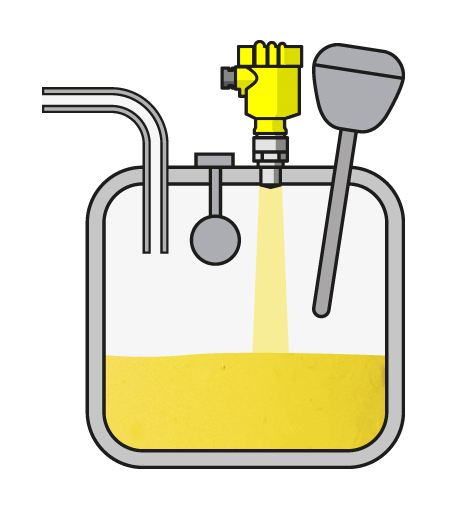
Plant operators have struggled with unfocused radar for decades. The wide beam angle of 26 GHz sensors (and 6 GHz sensors before them) made it difficult for radar signals to miss agitators, heating coils and other vessel internals. The reflections from these installations distorted the echo curve and users were forced to make adjustments to monitor the true liquid level. The new high-transmission models have narrower beams that miss vessel installations—it’s as if they aren’t even there. That is welcome news in chemical and food production, where obtrusive internals are the norm and space is at a premium.
Superior focus makes for accurate measurement without adjustment, but it also opens the door for two other major benefits.
Small process fittings make 80 GHz sensors effective on small tanks.
Small process fittings make 80 GHz
sensors effective on small tanks.
Courtesy VEGA

Size

Because their focus is amped up, 80 GHz sensors have small antennas. The new VEGAPULS 64, for example, has the world’s smallest antenna and doesn’t require a large horn to focus its beam at the measured material. The instrument’s small size makes a huge impact, particularly as it applies to retrofitting. Plants can now integrate the most advanced radar devices into their process without shelling out thousands for modifications to their vessels. Smaller instruments, however, aren’t just good for old vessels; they can also help manufacturers stay nimble and market-responsive.
There’s a trend in the pharmaceutical and chemical industries toward batch production. Batching allows operators to produce seasonal and low-volume products with less financial investment. Small batches are produced in small vessels, where conventional wisdom says using radar is impossible due to small process connections. Thanks to the compact design of 80 GHz radar sensors, that is no longer true, and operators no longer have to sacrifice accurate measurement in the name of space. 

Resolution

Imagine looking at the picture on a standard definition television next to that of an HD TV. The high definition picture would be clearer, sharper, and more detailed due to enhanced resolution. Users will see a similar difference switching from low-frequency to high-frequency radar sensors.
When the level of liquid in a vessel gets low enough, 26 GHz radar reads the echo from the material and the echo from the tank bottom as one echo. This tells the user the vessel is empty when it isn’t and presents a natural handicap to process efficiency. 80 GHz devices measure liquid down to the last millimeter, giving users accurate data they can use to optimize their processes. Greater resolution is particularly important for shipbuilders, who count on precise level in large ballast tanks.
Thanks to Mr. Tischler of VEGA Americas for authoring the white paper excerpted in this article. Share your level measurement challenges with product application specialists, combining your own process knowledge with their product application expertise to develop effective solutions.

The Focus of 80 GHz Radar Level Instruments Applied to Bulk Solids

radar level transmitter 80 GHz flange mount
VegaPuls 69 - 80 GHz radar level transmitter for bulk solids
Courtesy VEGA
Level measurement of  bulk solids presents a range of challenges to process designers and operators. One instrument manufacturer, VEGA, has produced a video demonstrating a distinct advantage of utilizing 80 GHz radar level transmitters instead of those with lower operating frequencies. The demonstration shows actual instruments in use, along with displays of the actual output from the device. You should find it useful.

VEGA manufactures a wide range of instruments for measuring level, interface, density, and pressure for process control applications. Share your process measurement challenges with product application specialists, and combine your process knowledge with their product expertise to develop effective solutions.


Radar Liquid Level Measurement Through a Sight Glass

radar level measurement installed on tank sight glass
Radar level control installed at tank sight glass
Courtesy VEGA
Level measurement, ubiquitous throughout processing operations, can be accomplished through the use of a number of different technologies. VEGA, a globally recognized innovator in level measurement, has authored a white paper outlining how radar level measurement instruments can be successfully employed when installed on tanks with sight glasses. The white paper is excerpted below, and you can access the full article and a wealth of application expertise by reaching out to an application specialist.

The balance of this article is excerpted from "Using radar sensors to measure liquid level through sight glasses", released by VEGA on 10/25/2016.

Vessels with sight glasses permit users to measure liquid level in a unique way: by mounting a radar sensor above the glass. Radar instruments emit microwaves that penetrate the glass, reach the product inside, and reflect through the glass back to the sensor. This eliminates two major expenses because users are spared from retrofitting a tank to accommodate a sensor and can continue running a process during installation. Functionally, nothing changes as users can simply move the sensor for a moment to look through the glass and see what’s happening inside a vessel.

Challenges to radar level measurement through sight glass


Any radar sensor can measure liquid level through a sight glass, but what happens after a signal penetrates glass varies depending on the sensor. Glasses are often welded, bolted or clamped directly onto a vessel wall or roof with a circular flange, while others are mounted on a nozzle. Radar sensors with a transmission frequency of 26 GHz release wide beams that contact the sides of the flange, the nozzle, and sometimes the roof of the vessel itself. This creates noise at the top of the output, especially on taller nozzles, forcing operators to leave empty space inside a tank to make a clear distinction between the signal received from the vessel and the signal received from the product.

Further complicating the use of 26 GHz sensors with sight glasses is the fact that most sight glasses are installed at a natural slope in the tank. Angled glasses narrow the path to the liquid, increasing the degree of difficulty in setting up a sensor so the beam is perpendicular to the product. Perpendicularity is important because it’s in direct relationship to the strength of the signal the sensor receives. However, to minimize the small signals that bounce from the glass to back the sensor, it’s recommended that users pair a 26 GHz radar sensor with a sight glass installed at a 45° angle. This forces users to choose between a strong signal from the product accompanied by reflections from the glass or a weak signal from the product and no reflections for the glass. Neither scenario is ideal.

Enhanced signal focusing makes all the difference


The problem of noise from fittings and narrow paths can be solved by installing a radar sensor that operates at a higher transmission frequency and produces a more focused signal. The VEGAPULS 64, for example, has a frequency of 80 GHz and can emit a beam angle of only 3°. 26 GHz sensors, on the other hand, emit beam angles of approximately 10°. A narrow beam angle misses the sides of the flange and the nozzle, silencing signal noise. That same focused beam can travel a tight path to the product without sacrificing signal strength. Finally, 80 GHz radar sensors don’t need sight glasses at extreme angles to minimize reflected signals, as a sight glass installed at a 5-10° angle will do.

Other benefits of external level instruments


All this is welcome news to processes where sight glasses already exist and is also noteworthy for those struggling with level measurement technology in traditional tanks. Users in the latter camp may find it more economical to install an external radar level sensor and a sight glass than a new internal instrument because removing a sensor from the interior of a vessel presents users with several benefits. In applications involving harsh, caustic liquids, there’s no risk of the product damaging the sensor with a quick splash or corroding it over time through buildup. This saves users in routine maintenance costs, and lack of exposure extends a sensor’s life. Users can mount a radar sensor above such tanks, and the emitted microwaves penetrate the glass and reliably measure the harsh liquid inside.

External access to a level measurement instrument is also useful for a quick repair or recalibration. With the sensor on the outside of the vessel, users can keep the plant’s process moving while they perform routine maintenance. If a problem arises with an instrument inside of a tank, that particular tank—or worse, an entire line—might have to be shut down, potentially leading to thousands of dollars in lost production. What company can afford that?

Summary


In conclusion, radar sensors of any transmission frequency can be mounted above sight glasses for accurate, non-contact level measurement. Separation from the product helps preserve sensors, and the instruments are easy to access when calibration and maintenance are necessary. When researching their options, users should consider 80 GHz sensors because they emit focused radar beams that take a narrow path to the liquid and fewer signals are reflected by flanges and mounting nozzle interiors. Given radar technology’s accuracy and reliability, and all that can go wrong if an internal level measurement fails, a radar sensor mounted above a sight glass offers nothing but advantages.

Magnetic Liquid Level Gauges in Industrial Settings

magnetic liquid level gauge coupled with guided wave radar liquid level gauge
Magnetic liquid level gauge combined with
guided wave radar in a single assembly
Vega Americas
Magnetic liquid level gauges are an excellent alternative to sight glass level gauges for many process measurement applications. Their reliable performance and adaptability to process requirements has made them a primary choice in the industrial arena.

Essentially, a magnetic level gauge or magnetic level indicator, is a sight glass with enhancements that provide better readability and a form factor enabling the inclusion of additional level monitoring functions on the same device. Where a sight glass requires operator proximity to read liquid level, the magnetic level gauge's indicating scale, or flags, can be clearly viewed from a considerable distance. A sight glass gauge can also be hindered by difficulties in visually determining liquid level because of deterioration of the glass surface or physical properties of the liquid. Magnetic level gauges remove the need to observe the liquid directly by incorporating a float device within a tube connected to the liquid containing vessel. As the float moves in response to liquid level changes, its magnet causes the indicator flags on the scale to rotate and display either a black face, indicating no liquid present at that position, or a colored face.

Magnetic level indicators or gauges can be modified with a range of options, including armored casings to protect the tube and float arrangement and limit switches to signal attainment of predetermined liquid levels. Combining a magnetic level indicator with another level measurement technology, such as guided wave radar or magnetostrictive, in a single assembly can provide an analog process signal representing continuous liquid level and serve as a redundant measuring device for critical applications.

The document included below provides illustrated detail about the devices and their proper application. There is more detail available, so share your process measurement requirements and challenges with instrumentation experts. The combination of your process knowledge and their product application expertise will produce effective solutions.


Hydrostatic Level Measurement

submersible pressure sensor transmitter
Submersible Pressure Transmitter
VEGA
Liquid level can be inferred by accurately measuring the pressure produced by the height of a fluid column and knowing the density of the liquid measured. The measurement is comparative in nature, referencing some external pressure as a zero point. The zero point can be the surrounding atmospheric pressure, tank pressure, or the pressure exerted by another column of liquid contained elsewhere.

There are uncountable application scenarios, each with its own set of special conditions. Proper instrument selection, installation and calibration are essential to generating reliable and accurate results.

The VEGA hydrostatic pressure transmitters are specially designed to provide level measurements across a wide range of liquids with different properties. Some units provide media temperature measurement as well. The product centers around three basic units, with numerous variants and options that can be used to configure an instrument for any application.

Browse the document included below to see application examples, setup instructions, and the extensive array of configurations available with these pressure transmitters from VEGA. Contact product specialists to share your application challenges and get effective solutions.


A Step Forward in Non-contact Radar Liquid Level Measurement

80 GHz radar level measurement device for industrial process control
VEGAPULS 64 80 GHz Radar Liquid Level Sensor
Employing non-contact level measurement in a process control operation has many potential benefits. Radar level measurement has gained acceptance as an accurate and reliable method of liquid level measurement. The process measurement instrumentation manufacturers have continually made strides in the evolution of their product offerings, providing more effective lower cost solutions.

VEGA, a global leader in the manufacture of level and pressure instrumentation for the process industry, has introduced a new radar liquid level sensor. The VEGAPULS 64 operates at 80 GHz, a substantially higher frequency than previous models. The higher radar frequency, along with some other improvements, deliver operational benefits.
Graphic of tank with internal coil and stirring devices showing radar level sensor beam
Tight beam focus accommodates
vessel internal fixtures
Courtesy VEGA

  • Measurement is unaffected by condensation or buildup on the antenna
  • High measurement certainty with product deposits on vessel walls
  • System is quickly available for operation after cleaning cycles
  • Tight focusing of the radar beam on the liquid surface provides easier setup and commissioning with complex vessel internal fixtures.
The radar level sensor is available with a number of connection fitting sizes, extending down to 3/4", which enable retrofitting of this improved technology to smaller vessels without extensive modification. There is also an encapsulated antenna variant that is suitable for hygienic or chemical applications.

There is more to learn about the advances in radar level sensors. Reach out to product specialists for more information. Share your level measurement challenges with the product specialists, then combine your process expertise with their product knowledge to produce effective solutions.
radar level sensor with encapsulated antenna for hygienic or chemical applications
VEGAPULS 64 Encapsulated Version

Level Measurement - Simple Accurate Bubbler Method

diagram of instrument arrangement to measure level using bubbler method
Instrument layout for level
measurement
Measuring liquid level in a tank or vessel can be accomplished in a number of ways, all of which require some arrangement of instrumentation to either infer the liquid level from the measurement of a related physical property, or directly deliver the liquid level visually using a scaled gauge arrangement. One indirect method of level measurement is often referred to as the bubbler method, so named because it employs a purging gas that continually vents from the bottom of a tube extending into a tank of liquid. Through a simple apparatus, the level of a liquid can be inferred by the amount a back pressure exerted upon the gas flowing through the tube.

Probably the greatest advantage of this method of liquid level measurement is that the liquid does not contact the sensing instrumentation. The only portion of the apparatus in contact with the liquid is a tube immersed into the tank. Basically, a purge gas flows through the immersion tube and may bubble out the immersed end of the tube, which is open to allow the contained liquid to exert a hydrostatic pressure on the purge gas. The back pressure on the gas that is exerted by the liquid contained within the tank will vary directly with the depth of the liquid. The back pressure can be correlated to a liquid level. The accuracy of the measurement is related to the proper regulation of the purge gas (explained in the application note below) and the measurement capability of the pressure transmitter. Once the depth of the liquid is derived, further calculations, employing tank shape, dimensions, and the liquid density can provide an indication of the volume and mass of the liquid. Here is an illustration of the setup, provided courtesy of Yokogawa, a recognized leader in flow and pressure measurement with a global presence. Included below, an application note from Yokogawa on applying rotameters to the setup, as well as data sheets for the instruments employed in the illustrated apparatus.

Share your level measurement challenges of all types with the application specialists at Classic Controls. Combining your process expertise with their product application knowledge will yield the best process measurement and control solutions.